A
Fitted wardrobes
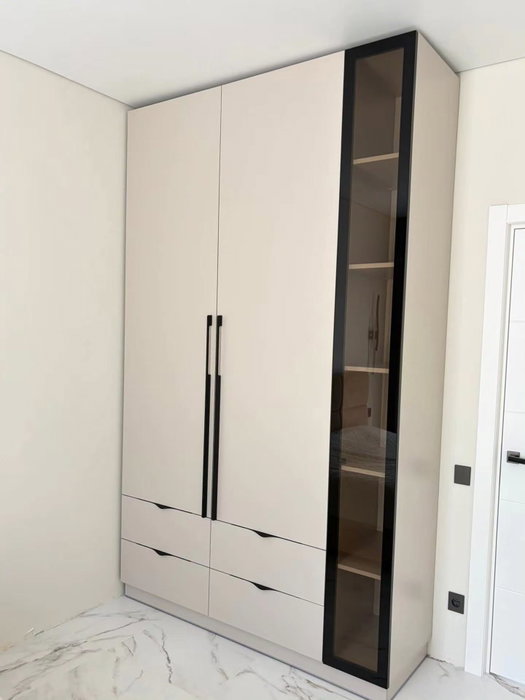
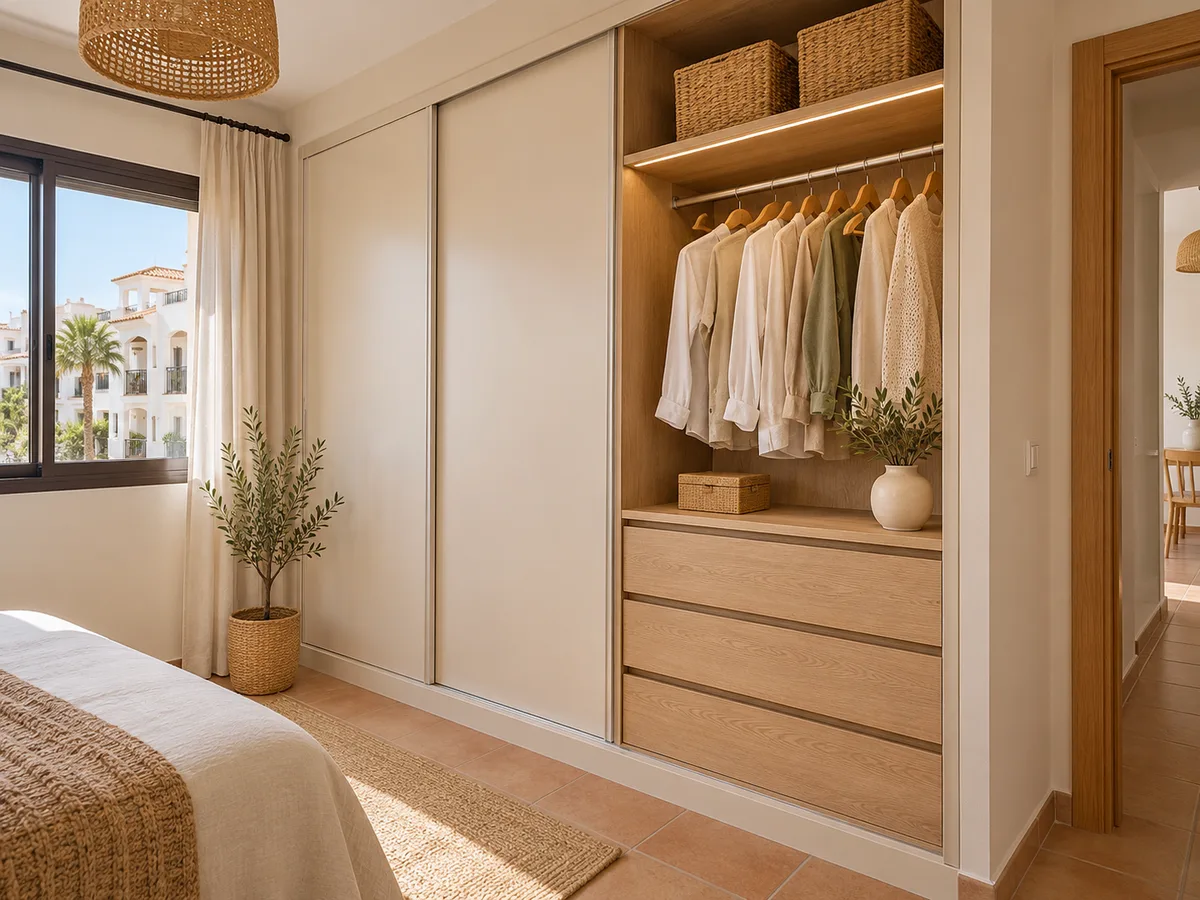
For gaps between walls, alcoves and corners. Floor to ceiling and a precise fit, even when the walls aren't square.
Ideal for alcoves, ends of corridors and older built-in cupboards.
Made-to-measure wardrobes and walk-in wardrobes · Calp
Made-to-measure wardrobes in Cometa III are ideal for solving a very specific problem: low-ceilinged spaces, a sloping ceiling or a corner that no off-the-shelf furniture fills. A bespoke design turns those square metres into useful storage. Here you'll see how to measure up a sloping wall, which modules work under a pitched roof and what information to gather to request an estimate for your project.
Try out the measurements, plan the interior layout and choose your finishes. See your idea take shape and share it with us so we can prepare your quote.
Send us your configuration with your measurements and we'll give you a guide price within 24 hours, free of charge. The measuring visit at your home comes afterwards.
01 — Solutions in Cometa III
For gaps between walls, alcoves and corners. Floor to ceiling and a precise fit, even when the walls aren't square.
Ideal for alcoves, ends of corridors and older built-in cupboards.
Complete wardrobes with doors that need no room to open. With mirror, glass or other finishes.
Ideal if the bed is close by or you have less than 1 m clear in front.
Open or closed, straight, L-shaped or U-shaped. Laid out around what you store, not around a standard module.
Ideal from around 1.5 m wide.
02 — In Cometa III
Say you have a room under the roof in your Cometa III home and you want a wardrobe that reaches right up to the sloping ceiling, without leaving a dead gap between the furniture and the slope. That gap collects dust and wastes exactly the height that is hardest to gain. A single height measurement won't do: you need to note the height at several points. Measure from the floor to the ceiling every 30 cm along the wall, starting at the lowest point, and write down each figure along with its distance from the corner.
With that table, the wardrobe is divided into sections that follow the slope. The module in the lowest part can be a bench with drawers; the next, a short hanging rail; the tallest, a long hanging rail or several shelves.
Measure the angle too, with a spirit level or a phone app: the angle of the ceiling changes which garments will fit. Below 1 m in height, drawers and boxes work well; between 1 and 1.6 m, folded shirts or short garments; above 1.8 m, you can hang long clothes if the depth allows.
Tell us about your space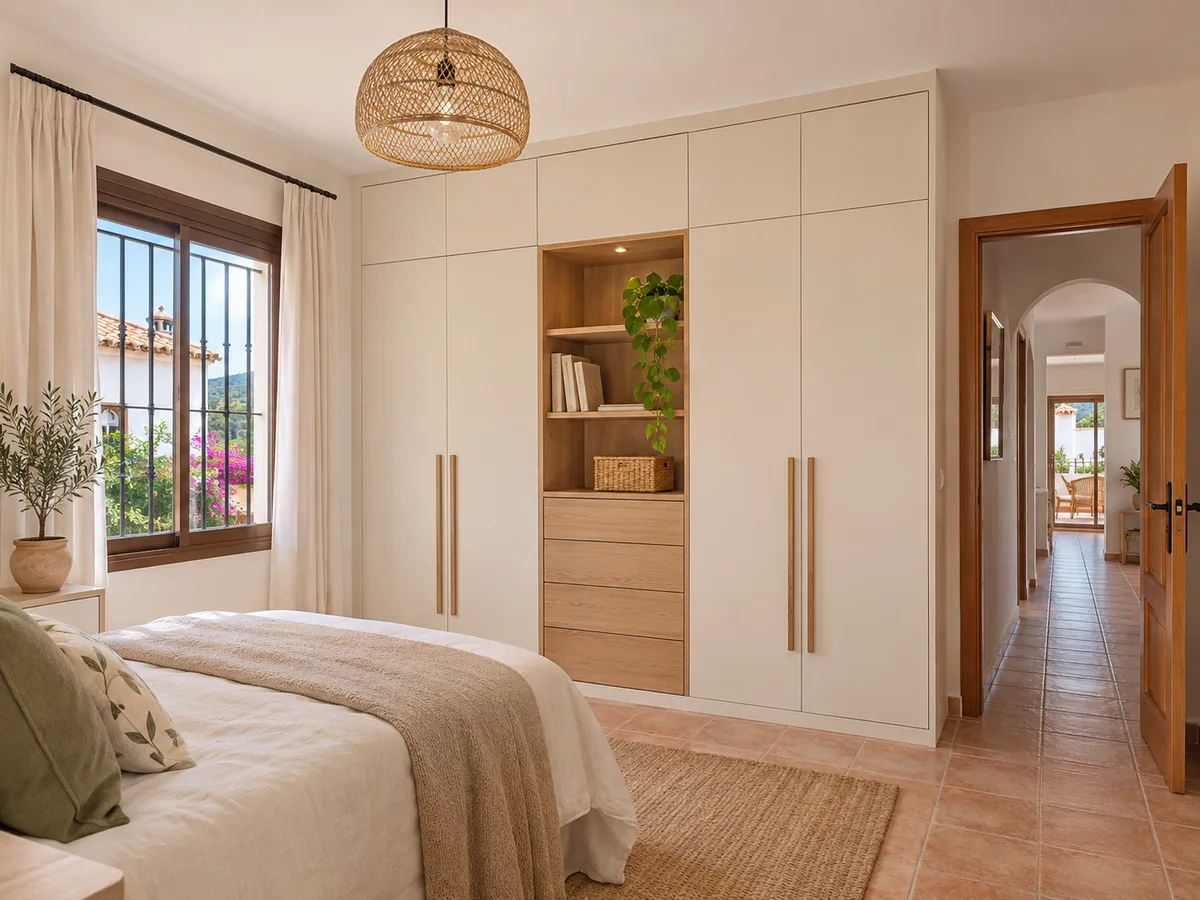
Latest work by SI, ARMARIO
@si.armario
Made-to-measure wardrobes and walk-in wardrobes
Latest posts
In the strip where the ceiling drops below 1.2 m, a wardrobe with doors isn't comfortable to use: it's awkward to bend down and see the back. Extra-deep drawers work better there, as they pull out towards you and show everything inside with no effort.
A drawer 60 to 70 cm deep holds blankets, bed linen and bulky footwear. If you prefer boxes, trays on wheels let you pull out everything stored in one go and slide it back without touching the wall.
To cover the whole area with a continuous front, our page on loft wardrobes explains how doors, drawers and filler panels are stepped so that the whole thing looks like a single piece.
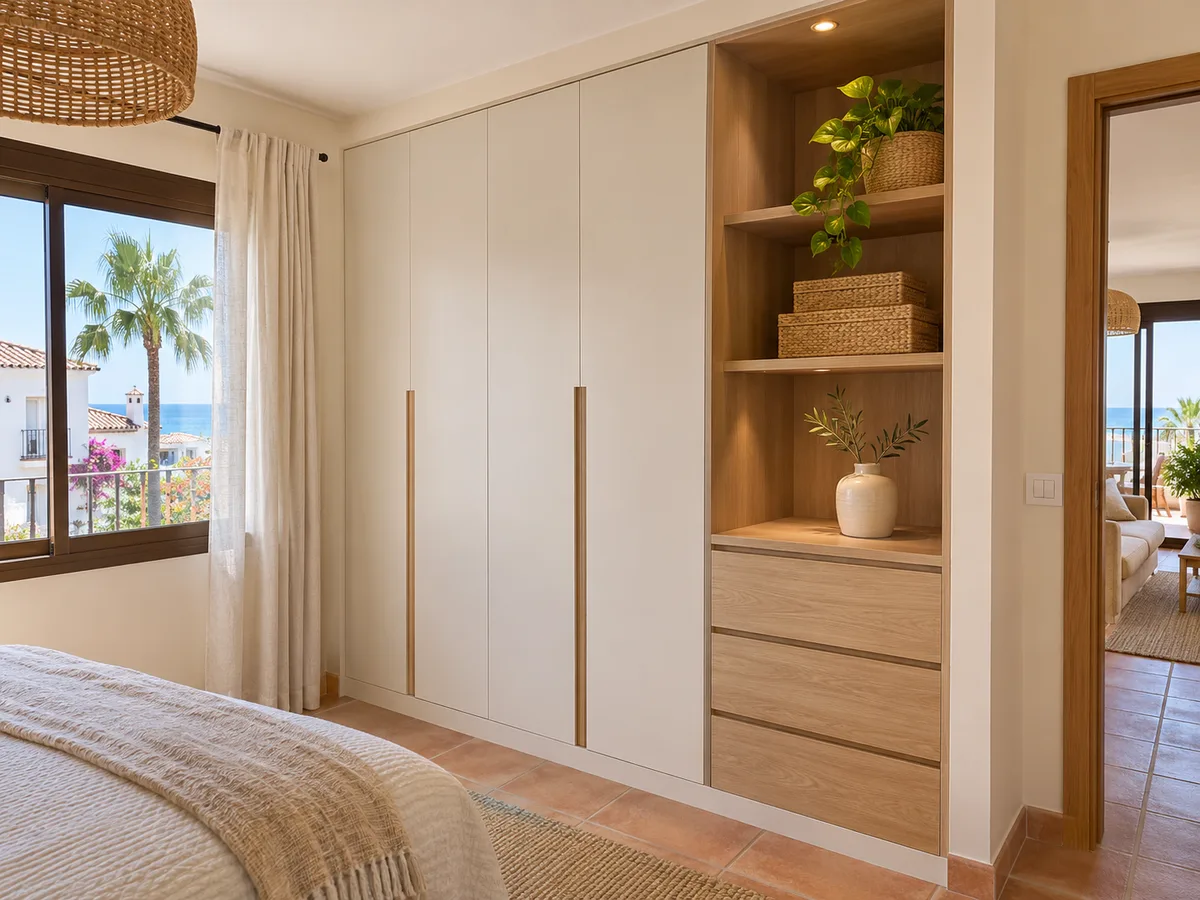
Where two walls meet in a bedroom in Cometa III, whether under a pitched roof or in an ordinary room, there's a gap that many wardrobes don't make use of. A corner module fills it with a hanging rail or a rotating shelf, although access is more limited than in a straight run.
There are two common solutions. The first is an L-shaped wardrobe with a door at the angle, giving a continuous front across two walls. The second is two straight runs with a corner set aside for items you use occasionally, such as suitcases or boxes.
The depth of that module is key in any wardrobe in Cometa III: with 60 cm on one wall and 40 on the other, the walkway doesn't narrow. Our page on corner wardrobes compares these options in more detail.
Send us a photo and the approximate measurements on WhatsApp and we'll give you some initial guidance.
Sometimes a bedroom wall in Cometa III is long but a door, window or radiator rules out a conventional wardrobe. A shallow wardrobe, 35 to 45 cm deep, gets round the obstacle and still stores the essentials: coats hung sideways, shelves with boxes, a narrow shoe rack.
The limitation is the hanging rail. At 40 cm deep, the hangers turn to the side and the clothes are harder to see. It's worth it if space is what you're short of; if not, a normal depth over a shorter run pays off more.
Think about the type of door too. With a shallow depth, a sliding door saves the swing arc, and a bifold door halves it. See our page on shallow wardrobes if your wall is narrow.
In a wardrobe in Cometa III, a rail at 100 cm from the floor suits shirts and jackets; one at 150 cm, dresses and coats. Placing them at different heights in adjoining sections makes better use of a sloping wall, because each rail goes where there's enough height.
Drawers are grouped in the lowest zone, and shelves in the middle. With this arrangement, someone standing in front of the wardrobe has everyday items at hand height and seasonal ones below or above.
If you're unsure about the layout, print out your inventory of clothes and assign it to each section with a pencil. In a room with a sloping ceiling, it's a simple way to check that nothing is left without a place.
To prepare your request for a wardrobe in Cometa III, note down the table of heights, the width of the wall, the available depth and the position of windows, radiators and sockets. Add photos of the whole wall, one of each end and one of the ceiling from below. With that, the team can understand the space without needing to visit.
Also tell us how it will be used: bedroom, study or children's room. Children need low heights and adjustable rails, and a home office needs shelves and drawers more than hanging space. How the room is used guides the layout.
The configurator collects this information and sends the design; it doesn't show a price, and the estimate follows afterwards.
Once the estimate is accepted, the measuring visit is scheduled. It costs €50, which isn't charged if you place the order; during it, each section of the ceiling is measured and we check that the modules fit the slope. The final quote comes from that.
Once the deposit is paid, manufacturing takes two to three weeks on average. In a wardrobe with a slope, each module is cut to a different height, so any change of measurements must be confirmed before ordering.
Installation is arranged separately. If your home in Cometa III has development rules or narrow stairs, tell the team when preparing the project.
Cometa III appears on street maps as a residential development in the municipality of Calp, and Calp Town Council mentions it alongside Empedrola and Canuta in a road-resurfacing project. Wikipedia notes that the place name La Cometa appears in local history, and that the hermitage of San Juan de la Cometa stands on the Tossal de la Cometa.
If you're interested in other nearby areas, see our pages for Gran Sol, Empedrola I and II and Carrió Alto.
The name of a development doesn't tell us what your home is like: we ask for the height, ceiling type and layout when we open your project, and we confirm the address with you before measuring.
Quote
With your name, a phone number and a photo of the space, we can get started.
What happens next
Frequently asked questions
Yes, we take on wardrobe and walk-in wardrobe projects in Cometa III, within the municipality of Calp. You send your configuration, we check the address with you and, if the estimate suits you, the measuring day is set.
Yes. The wardrobe is designed in sections that follow the slope: drawers in the lower part, short hanging rails in the middle and long rails where the height allows. For this we need several height measurements along the wall.
Note the height every 30 cm, from the lowest point to the highest, and the distance of each measurement from the corner. A couple of photos of the ceiling from below help to confirm the angle.
A corner module or an L-shaped wardrobe makes use of it. If there's a door or window very close by, a shallow depth gets round the obstacle and avoids losing walking space.
Once the deposit is paid, the wardrobe is made in two to three weeks on average. Installation is arranged separately and may take longer if the wall is sloping and the modules are of different heights.
Measure your wall section by section, prepare the configuration and receive an estimate for your wardrobe in Cometa III, even if the ceiling is sloping.