Interior layouts and storage for made-to-measure wardrobes in Calp
The inside of a wardrobe is where everyday convenience is won or lost. A good interior layout puts every garment at the right height, with drawers within easy reach and hanging rails where your coats actually fit. If you are looking for interior layouts and storage for made-to-measure wardrobes in Calp, here you will find how to plan hanging rails, shelves, drawers and accessories around what you really store, whether in a new wardrobe or one you already have.
Shape your next wardrobe.
Try out the measurements, plan the interior layout and choose your finishes. See your idea take shape and share it with us so we can prepare your quote.
Send us your configuration with your measurements and we'll give you a guide price within 24 hours, free of charge. The measuring visit at your home comes afterwards.
Work out what you keep and how often you use it
The first step in designing the inside of a wardrobe is not measuring, but emptying it in your head. Make a simple inventory: how many items hang, how many are folded, how many pairs of shoes there are and which accessories pile up. Sort what you reach for daily, what you use every week and what only comes out in season.
That split decides the heights. Daily items go between waist and eye level, where your hand reaches without effort; weekly items a little lower or higher; seasonal ones in the top cupboard or in deep drawers. Once you have your list, you work out the metres of hanging rail and the stacks of folded clothes, and the interior project for your wardrobe in Calp starts from facts, not guesswork.
Measuring the usable interior with the doors open in Calp
The width of the wardrobe is not the usable space. The sides take up their 16 or 18 millimetres, the runners and hinges steal a few more centimetres, and the doors, when open, can limit how far the drawers pull out.
That is why the usable interior is measured with the doors in the open position. In a wardrobe with hinged doors, check that each drawer unit comes out fully without catching on the door frame or the edge of the door. In a sliding-door wardrobe, work out which modules end up behind the fixed panel. If you do this before the design, you avoid the drawer that only opens halfway. And don't forget to measure the clear height above the skirting board and below the ceiling, because every section of rail or shelf comes from that.
Dividing up hanging rails, shelves, drawers and top cupboards
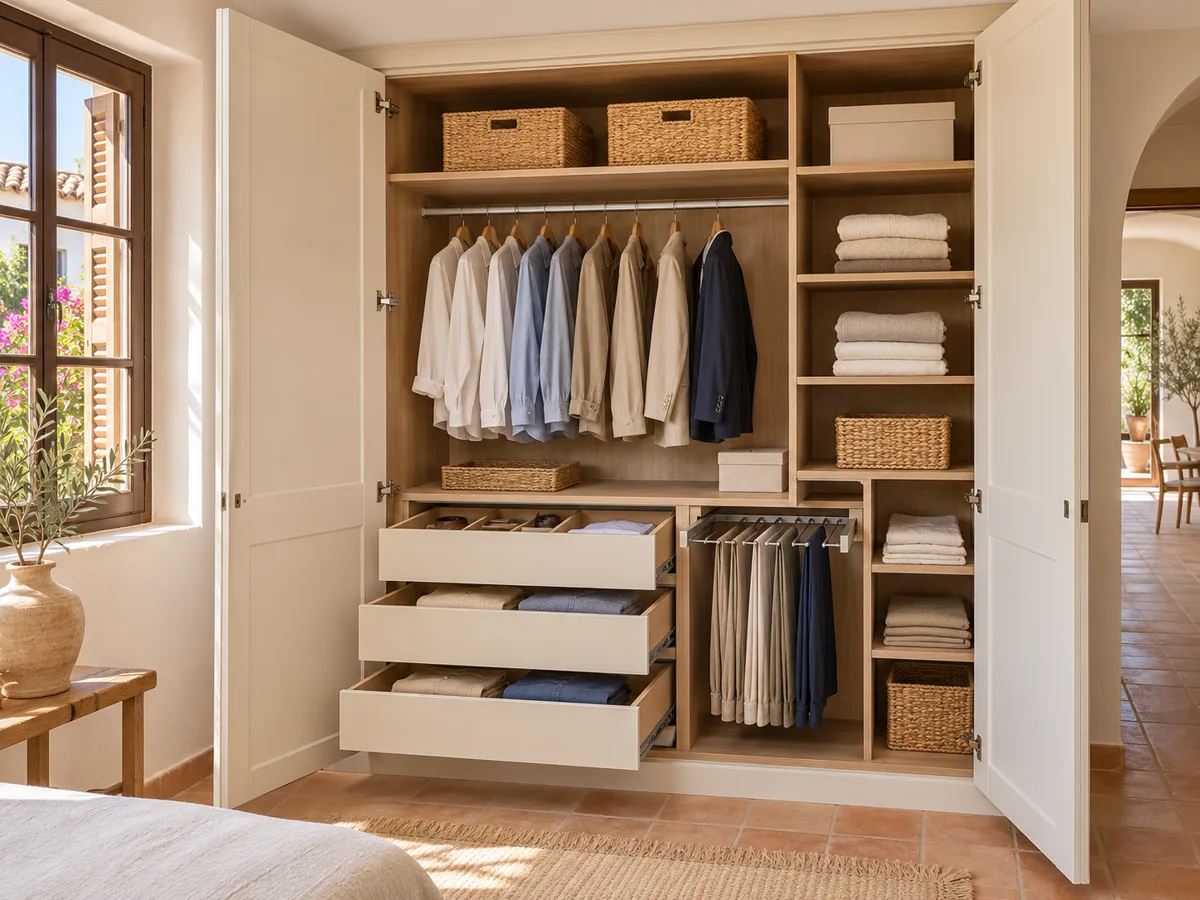
A well-planned interior combines four elements. The short rail, with a drop of about 100 centimetres, holds shirts, jackets and skirts and leaves a useful space underneath. The long rail, 160 to 170, takes coats and dresses. Shelves, 30 to 40 centimetres deep, keep folded clothes tidy. And drawers hold the small things: underwear, socks, belts.
The top cupboard, above eye level, completes the set with off-season clothes, suitcases and bedding. If the wardrobe is tall, a pull-down handle for the top cupboard saves you climbing onto a chair. Two practical rules: hanging clothes need at least 55 centimetres of depth for the hangers, and fixed shelves work best when they can be moved to a different height later on.
Have you already measured the space?
Send us a photo and the approximate measurements on WhatsApp and we'll give you some initial guidance.
Shoes, long garments and small accessories
- 01
Shoes are what waste the most space. A flat shelf wastes height; a sloping one or a pull-out shoe rack holds more pairs in less width. If you have boots, it is worth having a zone with its own height, of around 40 centimetres, so you don't have to fold them over.
- 02
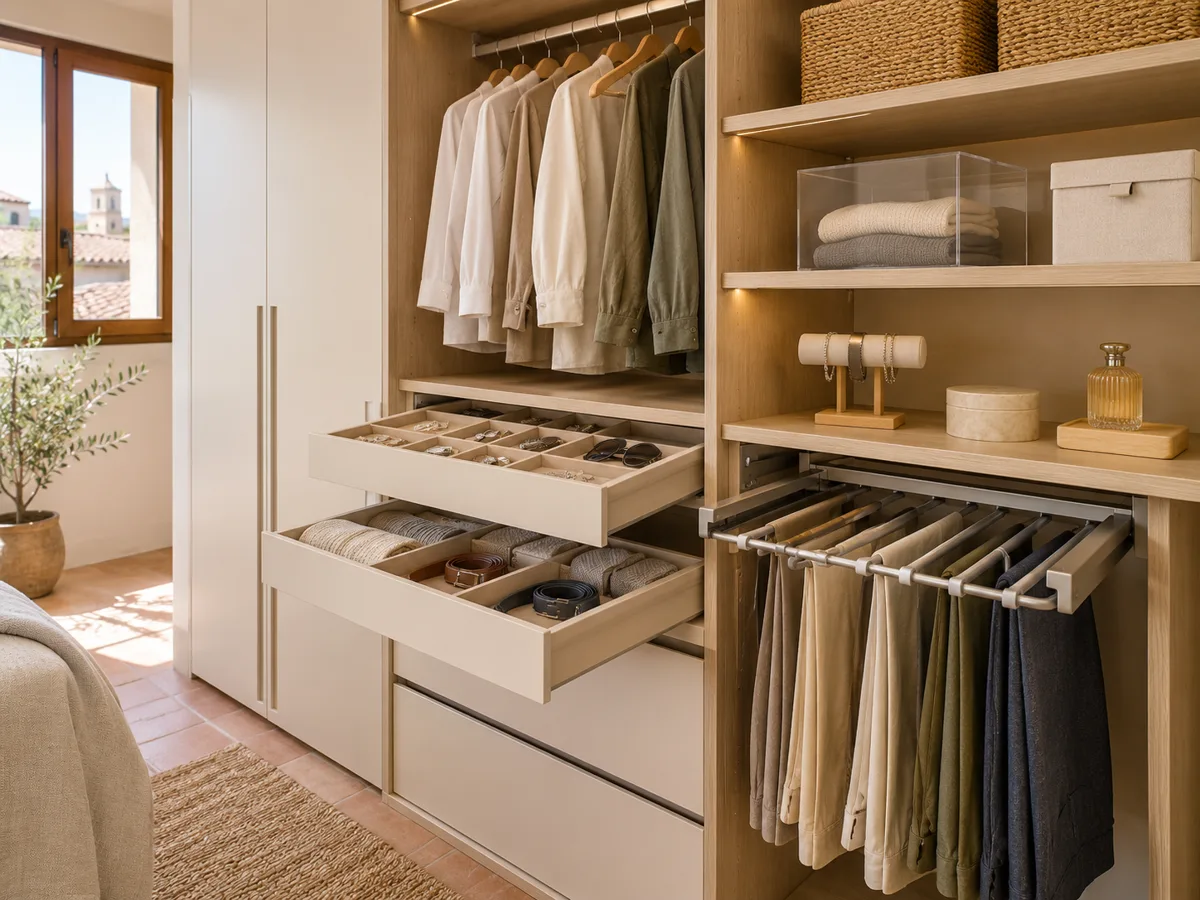
Long clothes call for a single rail and a section with no drawers underneath. The usual approach is to dedicate one of the side modules to them, top to bottom, and keep the centre for shorter items. As for accessories, belts, ties and costume jewellery fit in drawers with dividers or in pull-out accessories that take up little room: a side belt rack or a velvet-lined jewellery tray makes all the difference in a small wardrobe.
Adapting an existing wardrobe: what can be kept
Often the wardrobe is good but the interior isn't. In that case you can renew just the inside: rails, shelves, drawer units and lighting, keeping the carcass and the doors. Before deciding, check three things. That the sides are straight and firm, that the back panel is neither damp nor swollen, and that the doors close without rubbing.
If the structure holds up, the new interior is made to measurements taken inside the wardrobe and fitted without removing anything. If the sides are not usable or the back panel is inadequate, a new unit will work out better. Send us photos of the open wardrobe, with a tape measure in view, and we will tell you what can be saved and what can't.
Latest work by SI, ARMARIO
@si.armario
Made-to-measure wardrobes and walk-in wardrobes
Latest posts
Accessories that earn their place and accessories you can do without
Not every accessory is worth what it costs. The ones that change daily use are few: the pull-down rail for reaching high items, the pull-out trouser rack, the sliding shoe rack and the drawer with an organiser insert. They work because they solve something you do several times a week.
Others look appealing but are rarely put to use: carousel trays in wardrobes with no corner, scarf hooks nobody uses or decorative glass-fronted drawers. Before adding them, ask yourself how much use you would get out of them. A good rule is to include an accessory only if you can say which garment or object it will hold. The rest stays as a free shelf, which always gets used.
Ask us to come and measure up in Calp
- 01You leave us your name and your area.
- 02We message you on WhatsApp to agree a day.
- 03The measuring visit costs €50 and is free if you place an order.
Interior materials and fittings
The interior is usually made from melamine board, with protected edges so they stand up to the rub of hangers. Thickness matters: a 16-millimetre shelf holds up well to about 80 centimetres wide; beyond that it sags under weight, and it is worth doubling the edge or adding a central support.
With drawers, quality shows in the runners. Full-extension runners with soft-close let you see the whole drawer and prevent bangs. Handles or push-to-open are chosen to suit the style of the fronts. In a home in Calp close to the sea, it is worth having the metal fittings treated against humidity, and not leaving the wardrobe pushed against the colder outer wall without a small air gap.
What determines the quote for the new interior
- 01
The cost of the interior depends on how much it contains. The linear metres of board set the baseline. Drawers, with their runners and fronts, are the biggest item, because each one has its own hardware. Pull-out accessories are added per unit. And if you are changing the interior of an existing wardrobe, you need to allow for removal and for fitting to the measurements already taken.
- 02
The configurator is there to put numbers on it: you enter the dimensions, choose module types and receive the design by e-mail. With it, the team will give you a price guide within 24 hours. If you decide to go ahead, the measuring visit costs €50 and is not charged if you go on to place an order.
Enquiry
Tell us about your project in Calp
- 1We read your message and look at your photos.
- 2We reply on WhatsApp with a first figure.
- 3We measure up and prepare the final quote. The measuring visit costs €50 if you don't go ahead with the order and is free if you do.
We don't cut a single board until you've approved the design and the price.
Questions
Frequently asked questions about wardrobes in Calp
After installation: warranty and care for your wardrobe.
Can I renew the inside and keep my current doors?
Yes, as long as the structure is still in good condition. We take measurements inside the wardrobe and make a new interior that fits without touching the doors. The drawers are calculated so they don't clash with the hinges.
What should I check in an old wardrobe before renewing the interior?
The sides, the back panel and the base: they should be straight and dry. Also, the hinges or runners of the doors, because a new interior behind misaligned doors soon causes problems. A few photos with measurements let us assess it remotely.
How do I stop the doors from getting in the way of the drawers?
By leaving a gap between the drawer unit and the door frame, or by placing it in a module that doesn't sit behind a door panel. Full-extension runners help, but the fit is decided on the plan, with the doors open.
Do you make just drawers or individual shelves?
Yes. Each piece is studied against your wardrobe's measurements, and we confirm what can be made to measure for your space. They can also be added later to an interior that is already installed, if the design allowed for it.
What height is right for the hanging rails?
For short clothes, a drop of about 100 centimetres, with the rail around 170 from the floor if there is another one below. For long clothes, 160 to 170 centimetres. The exact height depends on who is using it, and is adjusted in the design.
How long does an interior take to make?
Manufacturing usually takes two to three weeks on average. The installation is scheduled separately, once the materials are ready and the wardrobe is prepared.
Shall we talk about your project?
Send us a photo of the space and some approximate measurements on WhatsApp: we'll give you some initial guidance and arrange the measuring visit.