Made-to-measure wooden walk-in wardrobes in Calp
When people talk about made-to-measure wooden walk-in wardrobes, the first thing to clarify is which wood they mean and where it goes in the overall design. In Calp we help you choose between solid wood, natural veneer and decorative board, and decide how to split them between the carcass, the doors and fronts, and the accessories. Once that decision is made, the configurator turns your measurements into a design ready for a quote.
Shape your next wardrobe.
Try out the measurements, plan the interior layout and choose your finishes. See your idea take shape and share it with us so we can prepare your quote.
Send us your configuration with your measurements and we'll give you a guide price within 24 hours, free of charge. The measuring visit at your home comes afterwards.
Which surfaces will show the wood
A made-to-measure wooden walk-in wardrobe doesn't need to be wooden on every surface. The wood shows most on the drawer fronts, the exposed shelves, the side panels you see as you walk in, and the hanging rails. The inside of the units, the back panels and the hidden parts do their job perfectly well in a simpler, more stable material.
Starting with this question saves you decisions and money: we draw the room, mark what can be seen from the doorway and reserve the best material for those surfaces. The rest is settled on technical grounds. In Calp, where many walk-in wardrobes occupy a bedroom with plenty of natural light, the wood on the fronts will be seen every day and deserves the best choice.
Solid wood, natural veneer and decorative board
Solid wood is the most noble and the most expensive, and it behaves like a living material, expanding and contracting. In a walk-in wardrobe it is used for specific pieces: a front panel, a rail, a handle, a plinth. Natural veneer is a thin sheet of real wood bonded to a stable board; it gives you authentic grain with better stability and covers large surfaces.
Decorative board imitates wood with a printed or textured finish. It is hard-wearing, uniform and affordable, and works very well inside. The key is to put each option where it performs best: solid wood for details, veneer on large fronts, decorative board where there is most wear. A walk-in wardrobe with wood veneer on the fronts and decorative board inside is a very common and sensible combination.
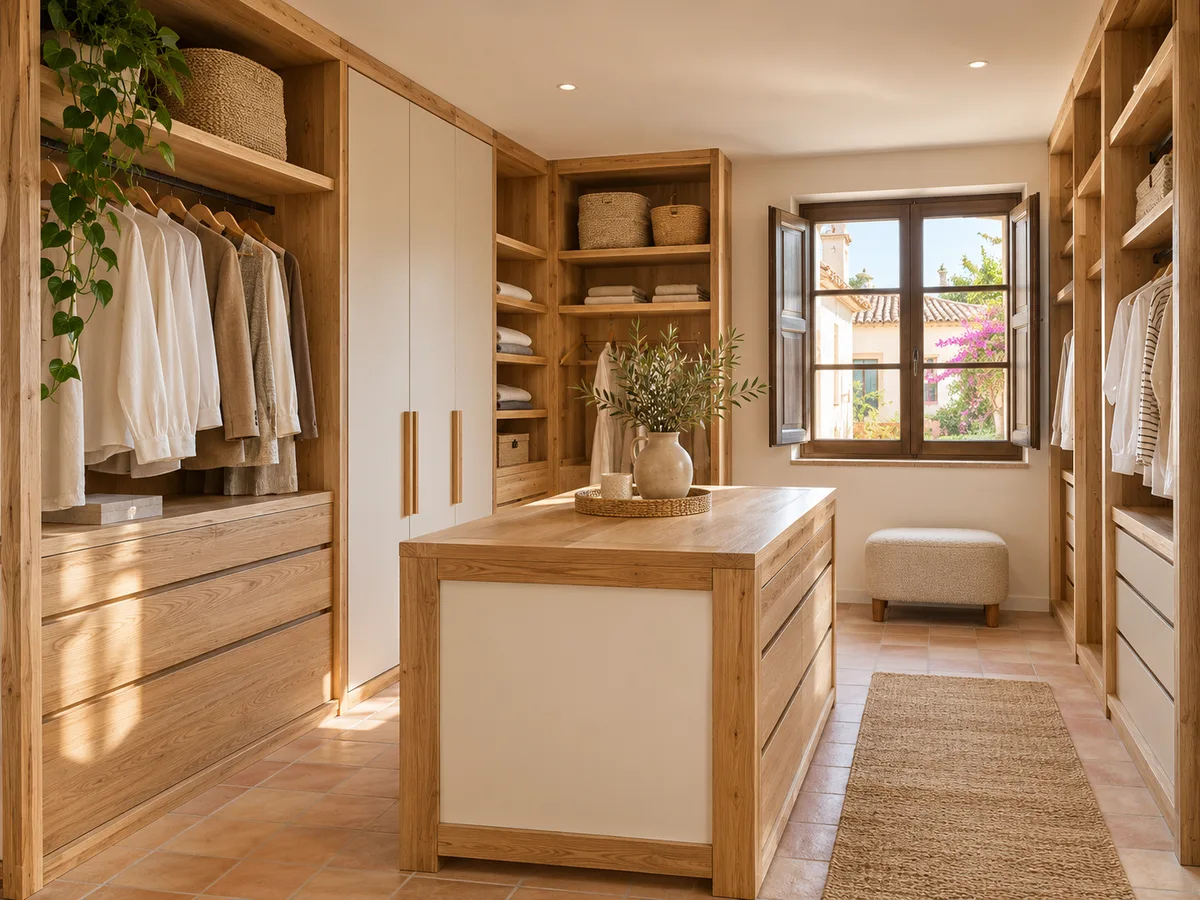
Materials for the carcass, fronts and accessories
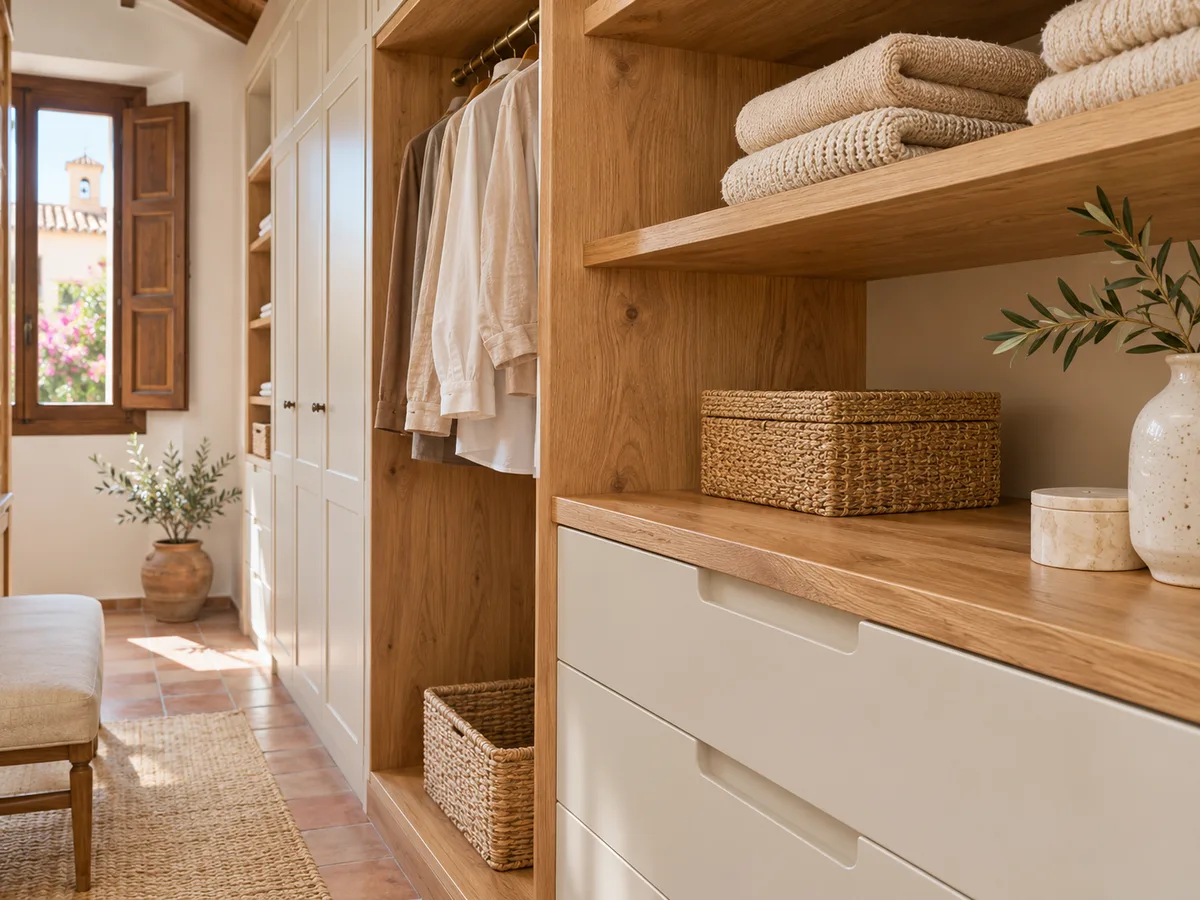
A made-to-measure wooden walk-in wardrobe combines layers. The carcass is usually made from good-density chipboard or fibreboard, which takes the weight of the clothes and holds its dimensions. The fronts can take the most eye-catching material, and the accessories, such as rails or handles, can be metal, wood or both.
Mixing materials is common and sensible: carcass in decorative board, drawer fronts in oak veneer, rails in steel. What matters is that the whole thing reads as a single piece from the doorway, and that the edges of every material are finished with the same care. A badly finished edge gives the mix away straight away.
Have you already measured the space?
Send us a photo and the approximate measurements on WhatsApp and we'll give you some initial guidance.
Tone, grain and physical sample
- 01
The name of a wood doesn't fix its appearance. Oak can be pale and almost whitish, or toasted; walnut ranges from chocolate to greyish brown depending on the stain and varnish. The grain varies too: straight and discreet, or open and full of character. That's why we work with physical samples, which you judge in the room itself.
- 02
A veneer looks different next to a window than beside an interior wall, and one piece of the sample won't exactly match the next, because natural wood varies from one board to another. That is part of its appeal. If you want a uniform wooden walk-in wardrobe, we order a selection of consecutive veneers so the grain runs on without breaks from one front to the next.
Combining wood with other surfaces
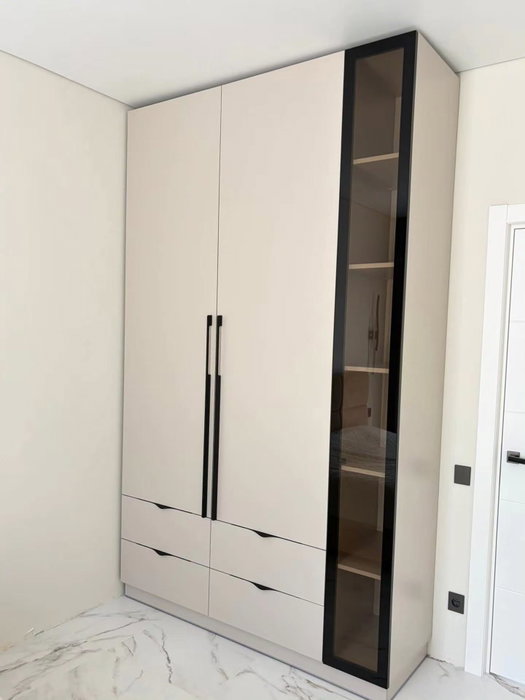
A walk-in wardrobe made entirely of wood can feel heavy. To balance it, the wood is alternated with plain surfaces: a neutral colour on the tall units, glass in a display cabinet, a mirror on the front of a closed wardrobe. That way the grain stands out where you want it and the design can breathe where you don't.
You can also combine wood with metal in profiles and rails, or with fabric on the back of a panel. In made-to-measure wooden walk-in wardrobes with several units, it works well to leave the central unit in wood and the side ones in a plain tone that frames it. The rule is that each material should have a reason to be there, and there should be no more than three stars in any one view.
Latest work by SI, ARMARIO
@si.armario
Made-to-measure wardrobes and walk-in wardrobes
Latest posts
Cleaning and performance by finish
In a wooden walk-in wardrobe, each finish needs different care. Varnished solid wood can be wiped with a slightly damp cloth and, from time to time, given a treatment to restore the finish. Veneer is cleaned the same way and appreciates not being drenched in water, especially at the edges and joints. Decorative board is the easiest: a cloth and little else.
In an area with humid air, such as the coast of Calp, we choose sealed finishes and avoid placing wide solid-wood pieces on exposed walls. A well-ventilated wooden walk-in wardrobe stays stable for many years. It is also advisable to leave a small gap between the furniture and the exterior wall, and not to fit it against a wall with damp from seepage, which no material forgives.
Ask us to come and measure up in Calp
- 01You leave us your name and your area.
- 02We message you on WhatsApp to agree a day.
- 03The measuring visit costs €50 and is free if you place an order.
How the material affects your quote in Calp
Material is one of the factors that weighs most on the cost of a made-to-measure wooden walk-in wardrobe, along with size, the number of drawers and the lighting. Solid wood over large surfaces pushes the total up quickly; veneer on a stable board costs less, and decorative board is the most economical option.
In a wooden walk-in wardrobe, a sensible approach is to spend where it shows: fronts and exposed shelves in quality wood, carcass and back panels in a sound, simpler material. With the design sent from the configurator, the team will guide you on the cost based on the materials you choose. It's best to talk about material before final measurements, because changing it later affects the quote more than any other adjustment.
Choosing a modern or rustic style
- 01
The same wood can end up in a sober walk-in wardrobe or a warm one. A pale oak with plain fronts and no handles gives a contemporary result; the same oak with pronounced grain, frames and iron handles leans towards rustic. That decision guides the choice of finish, edging and fittings.
- 02
If you are leaning towards one of the two directions, you can see the rest of our solutions, where modern and rustic walk-in wardrobes are covered separately. Manufacturing usually takes two to three weeks on average, and the measuring visit costs €50 if you don't go ahead with the work and is free if you do.
Enquiry
Tell us about your project in Calp
- 1We read your message and look at your photos.
- 2We reply on WhatsApp with a first figure.
- 3We measure up and prepare the final quote. The measuring visit costs €50 if you don't go ahead with the order and is free if you do.
We don't cut a single board until you've approved the design and the price.
Questions
Frequently asked questions about wardrobes in Calp
After installation: warranty and care for your wardrobe.
In which parts of the walk-in wardrobe does natural wood make sense?
Drawer fronts, shelves, exposed side panels, rails, plinths and details. The internal carcass usually goes in stable board, because it isn't seen and has to bear weight without warping.
How do I tell real veneer from a wood effect?
Veneer is a sheet of real wood: the grain doesn't repeat identically between pieces and you can feel the natural texture to the touch. A wood effect is a printed finish, with a more regular pattern and a uniform surface.
Do I have to use the same material throughout?
No, and it isn't recommended. Combining is the norm. A made-to-measure wooden walk-in wardrobe usually puts the fine material where it shows and keeps a simpler one for hidden areas or large surfaces.
When is the tone of the wood decided?
With physical samples of the finish, which you look at in the room in its own light. If you're torn between two tones for a wooden walk-in wardrobe, they are compared side by side and you choose before manufacturing begins.
Does a wooden walk-in wardrobe stand up to coastal humidity?
Yes, if sealed finishes are chosen and the room is ventilated. We avoid wide solid-wood pieces on very exposed walls and prefer veneer or stable board for large surfaces.
Shall we talk about your project?
Send us a photo of the space and some approximate measurements on WhatsApp: we'll give you some initial guidance and arrange the measuring visit.